Home The Playbook Directory
Learn
Settings Guide Field Guides & Resources Certifications
Get
Meshtastic Meshcore Reticulum Nodes About Contact
Node Star

Own the
Internet.

Neighborhood mesh networks that run without cell towers, without ISPs, and without anyone's permission. Free to use. Impossible to shut down.

A people's internet,
built from the ground up.

Web1 gave us information. Web2 gave us community. Web3 gave us ownership. The next step is owning the network itself — the physical infrastructure that carries every message, every GPS coordinate, every call for help. That's what we call Web4. And it's already being built, one $30 radio at a time.

01
Community-owned

Every node is owned by the person who bought it. No corporation owns the network. No one can raise prices, change terms, or shut it down.

02
Works when it matters

Cell towers fail in earthquakes, fires, and floods. Mesh networks get stronger under pressure. The nodes that remain keep routing messages.

03
Encrypted by default

Not a privacy policy. Not a promise. Cryptographic encryption baked into the protocol. There's no server to subpoena and no company to pressure.

Own the Internet Neighborhood Networks That Can't Be Shut Down
Zachary A. Perlman A Node Star Publication · nodestar.net

A complete guide to seeding your city.

Written for community organizers, not engineers. Own the Internet is a step-by-step guide to building a neighborhood mesh network — from buying your first $30 device to running your first community event to growing a city-wide network that can't be shut down.

Twelve chapters. No jargon. No prerequisites. Just the playbook that Germany already wrote in practice — and that your city is waiting for someone to put on paper.

Explore the Playbook →
Every network is important — perhaps most so those that support individual families and persons. Don't wait for others to build the networks you want to see.
Reticulum Network Documentation · Mark Qvist
Meshtastic Settings Guide

What do you
want to do?

Pick your goal — hiking, emergency prep, long range, privacy, solar power, IoT — and get the exact Meshtastic settings for it. Plain English. No guesswork.

Open Settings Guide →

Seed the network
in your city.

Mesh networks start with one person who decides to begin. Tell us where you are — we'll help you find your people. You can also subscribe to the Node Star newsletter for updates, guides, and new community launches.

Get involved →

Own the Internet:
Neighborhood Networks That Can't Be Shut Down

A complete community playbook for building mesh networks. Written for the person who wants to start, not the person who already knows how.

Download the Playbook

Free. Share it freely. Adapt it for your city. It belongs to whoever builds with it.

Download Free PDF →
Ch. 1
A New Kind of Internet — and Why Your City Needs It
The vision in plain English. Web1 was information. Web2 was social. Web3 was ownership. The next step is owning the network itself.
Ch. 2
The Ecosystem in Plain English
A non-technical map of the landscape. LoRa, Meshtastic, Reticulum — how the pieces fit together and how to explain it to someone else in two minutes.
Ch. 3
Why Your City Needs a Seed
The Germany vs. LA map. What a mature network looks like. The milestone ladder from 2 nodes to 200. Why the early mover owns the origin story.
Ch. 4
What You Actually Need to Start
One device. One friend. One afternoon. No license, no expertise, no permission. The full list of what you don't need is longer than what you do.
Ch. 5
Who to Talk to First
Five communities already pre-sold on this without knowing it — CERT teams, ham radio operators, Web3 builders, makerspaces, and privacy advocates.
Ch. 6
The 60-Second Pitch
Five versions of the same idea, each tuned to a different listener. The goal isn't comprehension in 60 seconds. It's curiosity.
Ch. 7
Your First 30 Days
A concrete week-by-week plan from zero to a small but real network. Minimum viable actions only — enough to keep momentum alive.
Ch. 8
Running Your First Event
How to engineer the "wait, that actually worked" moment. The format, run of show, what to have ready, and the critical 48-hour follow-up.
Ch. 9
Keeping Momentum
The three killers of grassroots communities — and the specific habits that prevent each one. What to do when you hit the trough.
Ch. 10
From Meshtastic to Reticulum
When and how to introduce the deeper layer without losing the community you built. Think of it as the highway system under the neighborhood roads.
Ch. 11
The City-Specific Playbook
How to read your geography, find your high ground, and adapt the playbook to your city. Los Angeles used as the working example throughout.
Ch. 12
Resources
Hardware buying guide, apps, maps, communities, and further reading — everything you need in one place.
Closing
Now Go Build It
The technology exists. The hardware is cheap. The playbook is in your hands. What if you could own the internet? You can.

Everything you need
to get started.

Hardware, apps, maps, and communities for building your mesh network. All links verified and community-recommended.

Europe built it.
Your city is next.

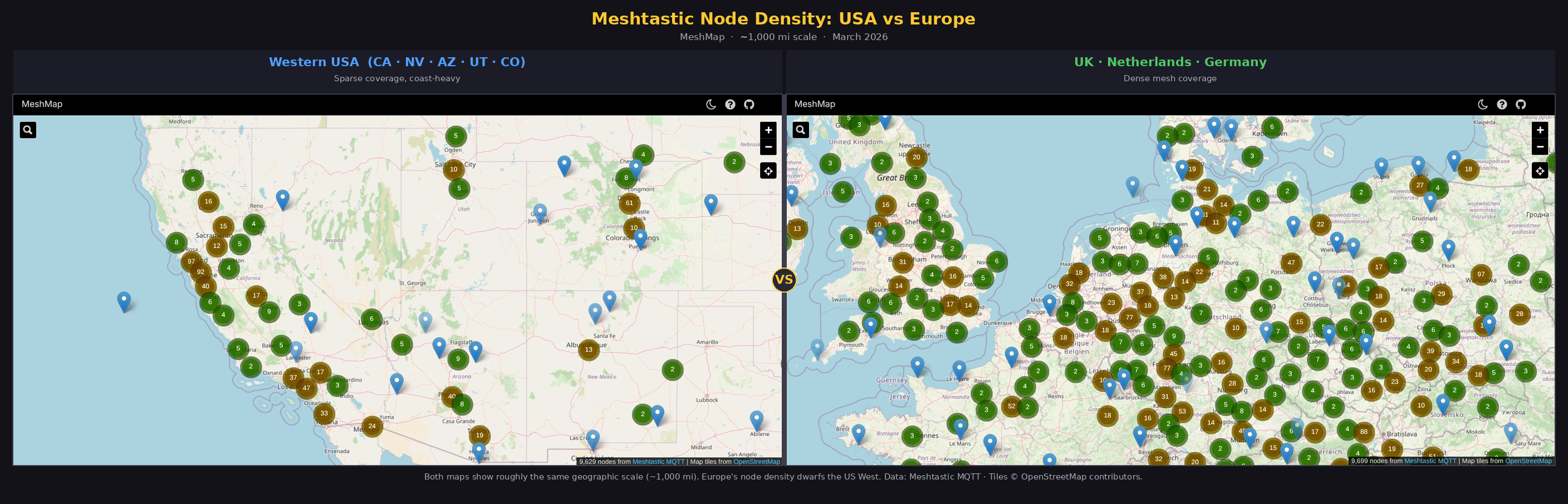
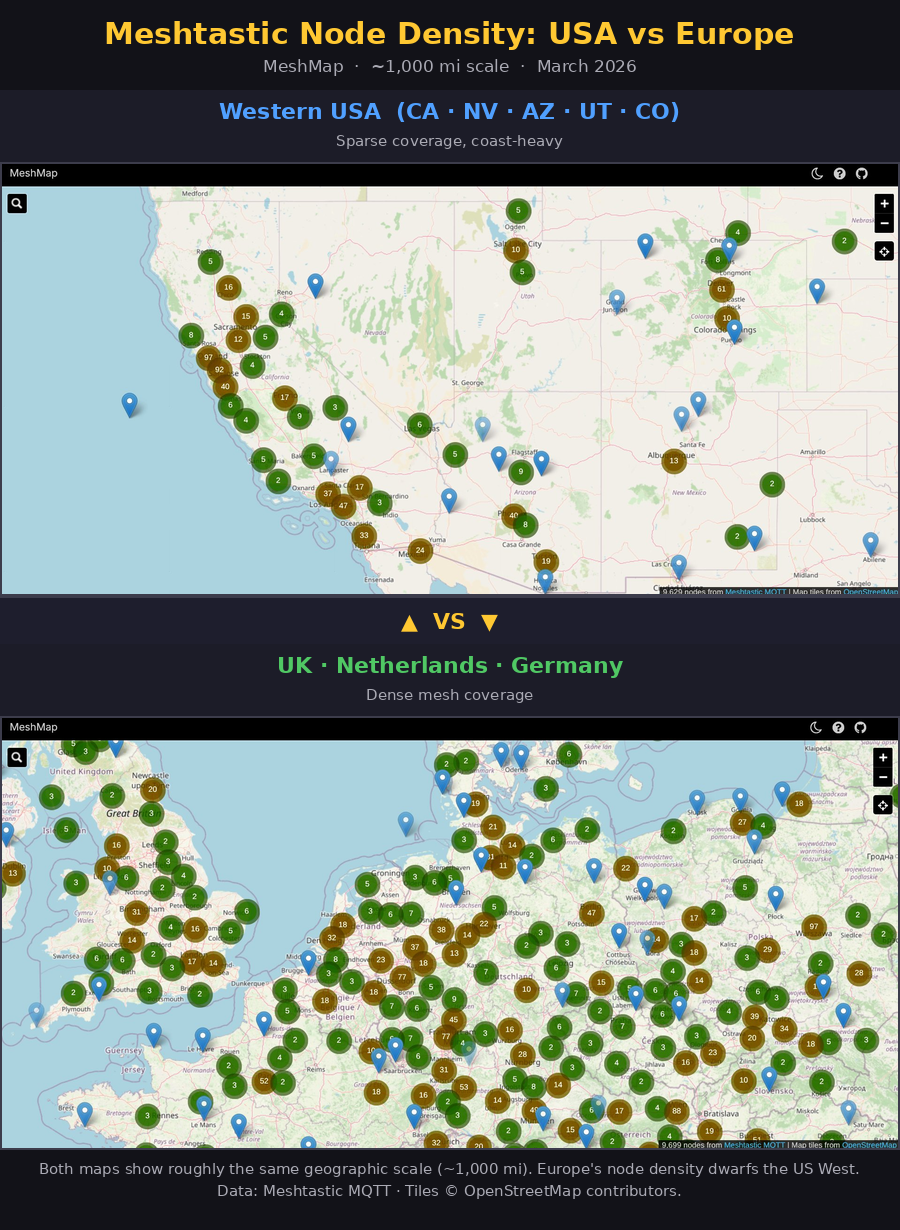
Both maps below cover roughly the same geographic scale (~1,000 mi). Europe's node density dwarfs the US West — not because of better technology, but because of earlier community organizing. The hardware is identical. The difference is who started.
meshmap.net
Side-by-side comparison: sparse Western USA Meshtastic nodes vs. dense UK/Netherlands/Germany coverage at the same map scale. Data from Meshtastic MQTT, March 2026. Stacked comparison: sparse Western USA Meshtastic nodes vs. dense UK/Netherlands/Germany coverage at the same map scale. Data from Meshtastic MQTT, March 2026.
Data: Meshtastic MQTT · Map tiles © OpenStreetMap contributors · meshmap.net · March 2026 View live →

Hardware

  • Heltec LoRa32 V3 (915MHz) The classic beginner device. $20–30 on Amazon with battery and case. Search "Heltec LoRa32 V3 915MHz Meshtastic."
  • Meshnology bundles Complete kits with 3000mAh battery, protective case, and antenna. Great for handing to a non-technical recruit.
  • RAK WisBlock Starter Kit More power-efficient nRF52840 chip. Better battery life for fixed relay nodes. Slightly more setup, worth it for permanent installations.
⚠ Always verify 915MHz for US operation. The EU version (868MHz) will not connect to US networks.

Apps

  • Meshtastic Free on Google Play and Apple App Store. Your primary interface for Meshtastic devices. meshtastic.org
  • Sideband The Reticulum messenger for Android, iOS (beta), Windows, macOS, Linux. Download directly from GitHub — not on the Play Store.
  • MeshChat Web-based Reticulum client with voice messaging and NomadNet browser. Great intro to Reticulum for visual people.
  • NomadNet Terminal-based client for hosting and browsing distributed mesh pages. The deep end of the rabbit hole.

Maps & Tools

  • meshmap.net The best live map of global Meshtastic nodes. Check your city's coverage, track your node count, find neighbors.
  • Meshtastic Site Planner Plan node placement using terrain data before you buy hardware. Essential for deciding where relays will have the most impact.
  • Reticulum Manual The definitive technical reference for Reticulum. Dense but thorough. reticulum.network/manual

Communities

  • r/meshtastic The most active English-language Meshtastic community. Good for troubleshooting, hardware questions, and finding people in your region.
  • Meshtastic Discord Real-time chat with developers and power users. Regional channels for finding local community. discord.com/invite/ktMAKGBnBs
  • Reticulum Matrix room The primary community for Reticulum and Sideband users. Search "Reticulum" on matrix.org to find active rooms.
  • CERT (your city) Community Emergency Response Teams. Find your local chapter through your city's emergency management office.
 nodes active on the global mesh  ·  Open live map →

What is
Node Star?

Node Star is a publishing and community project focused on decentralized communication infrastructure. We publish guides, tools, and resources for people who want to build neighborhood mesh networks — communication systems that belong to the community, not a corporation.

The name is deliberate. In mesh networking, every device is called a node. Stars are nodes in a constellation — distributed, connected, with no center. Node Star is what a healthy mesh network looks like from above: a community of independently-owned points of light, all talking to each other.

Node Star was co-founded by Zachary A. Perlman, Michael A. Spurling, and Daniel P. Cady. Perlman has diverse interests ranging from philosophy books to electric guitars, with a long-standing passion for decentralized systems and the question: what if you could own the internet?

The Web3 chapter of that story got complicated, as Web3 stories often do. The vision was right — the execution was ahead of its time. Web4 is the next chapter. And this time, the infrastructure is $30, pocket-sized, and already working in cities across Germany.

Node Star's mission is simple: publish the playbook, seed the community, and make it easy for anyone in any city to start. We don't own the network. Nobody does. That's the whole point.

Node Star is building toward a world where every city has a mesh network it owns. The first seed is being planted. Yours could be next.